OrionMoE-Small-v1.0 is the first model in Lexsi Labs’ OrionMoE family. It is a 37.7M-parameter tabular foundation model that classifies new rows in a single forward pass, with no fine-tuning. To our knowledge, it is the first tabular foundation model whose experts form the core of the backbone, with routing conditioned on a learned summary of the dataset. In its first version, it is the first MoE model to stand alongside frontier dense models. It rates within 31 Elo of TabPFN-3 on TabArena, above it on OpenML-CC18, and above Xiaomi-TabLDM on every suite where both are reported. Early access is open through the Lexsi API.
1. Motivation: tables vary, dense computation does not
In-context tabular foundation models such as TabPFN (Hollmann et al., 2025), TabICL (Qu et al., 2025), TabDPT (Ma et al., 2024) and LimiX (Zhang et al., 2025) have shown that a single pretrained network can be competitive across very different datasets. Most of them share one architectural property: the feed-forward transformations inside each block are dense and applied identically to every token, whichever feature or dataset it comes from. A new dataset changes the representations, through attention and context-dependent encoders, but not the computation applied to them.
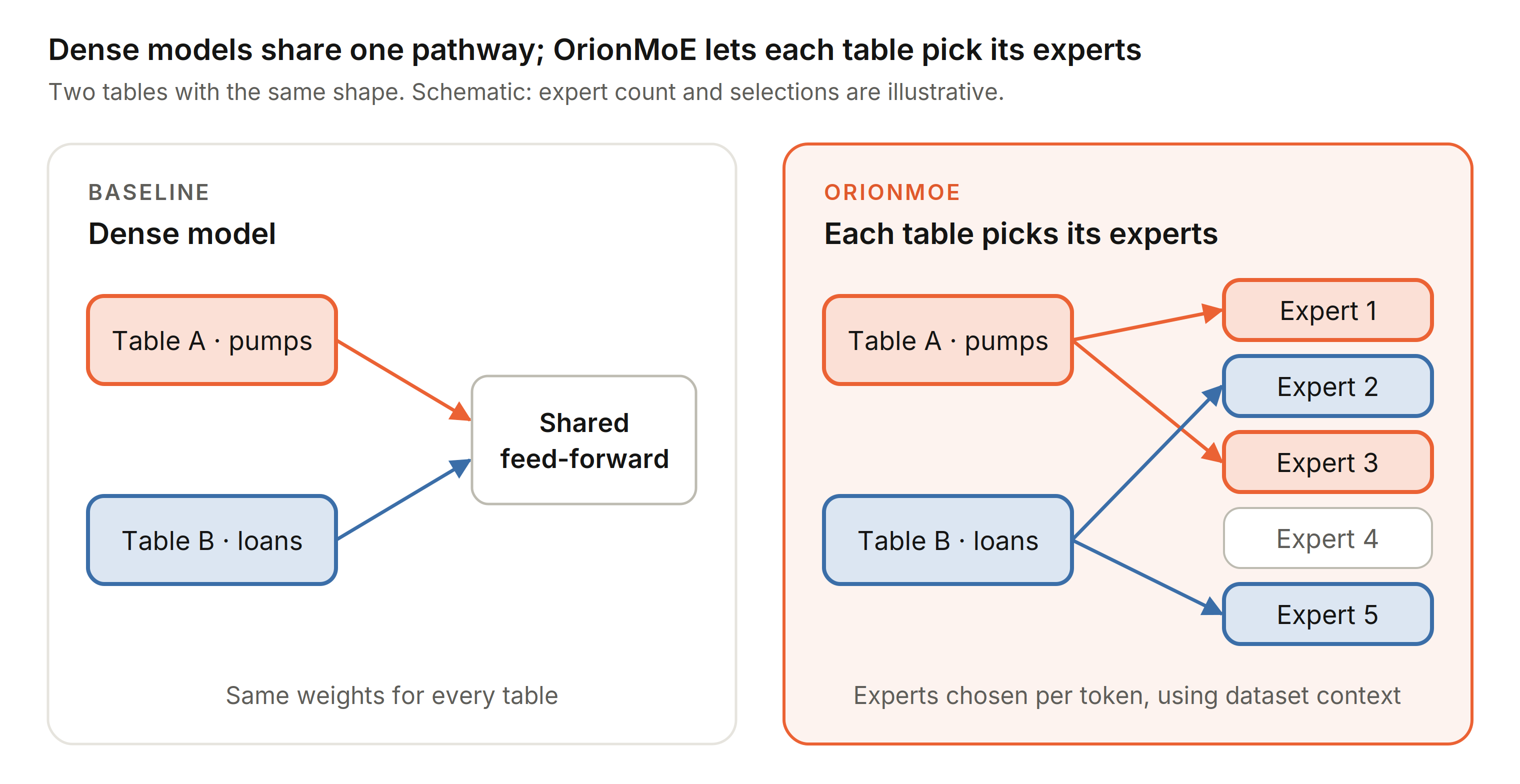
Tabular data makes this a real constraint. Features can be continuous measurements, categorical codes, counts or ordinal quantities, with different distributions, missingness patterns and relationships to the target, and datasets differ in size, dimensionality and label balance. Context-aware encoders handle part of this by giving the same value different embeddings in different datasets. We hypothesize that the allocation of computation should depend on the data as well: different features and datasets may be better served by different learned transformations.
If we take that hypothesis seriously, at least three architectural directions open up. They are complementary rather than competing.
OrionMoE-Small-v1.0 places two bets: on the first and, centrally, on the third. Adaptive information exchange remains an open and promising direction that we expect to return to.
2. Heterogeneity is the domain, not the noise
Images share a grid. Text shares a vocabulary. Tables share almost nothing. One table mixes continuous measurements, categorical codes, sparse counts and missing values. Another, with the same number of columns, obeys entirely different statistical relationships. Consider the number 10: it might be an age, a count, a sensor reading, or an arbitrary label for a category. Its meaning lives in the column’s distribution, its relationships to other variables, and the labeled examples around it.
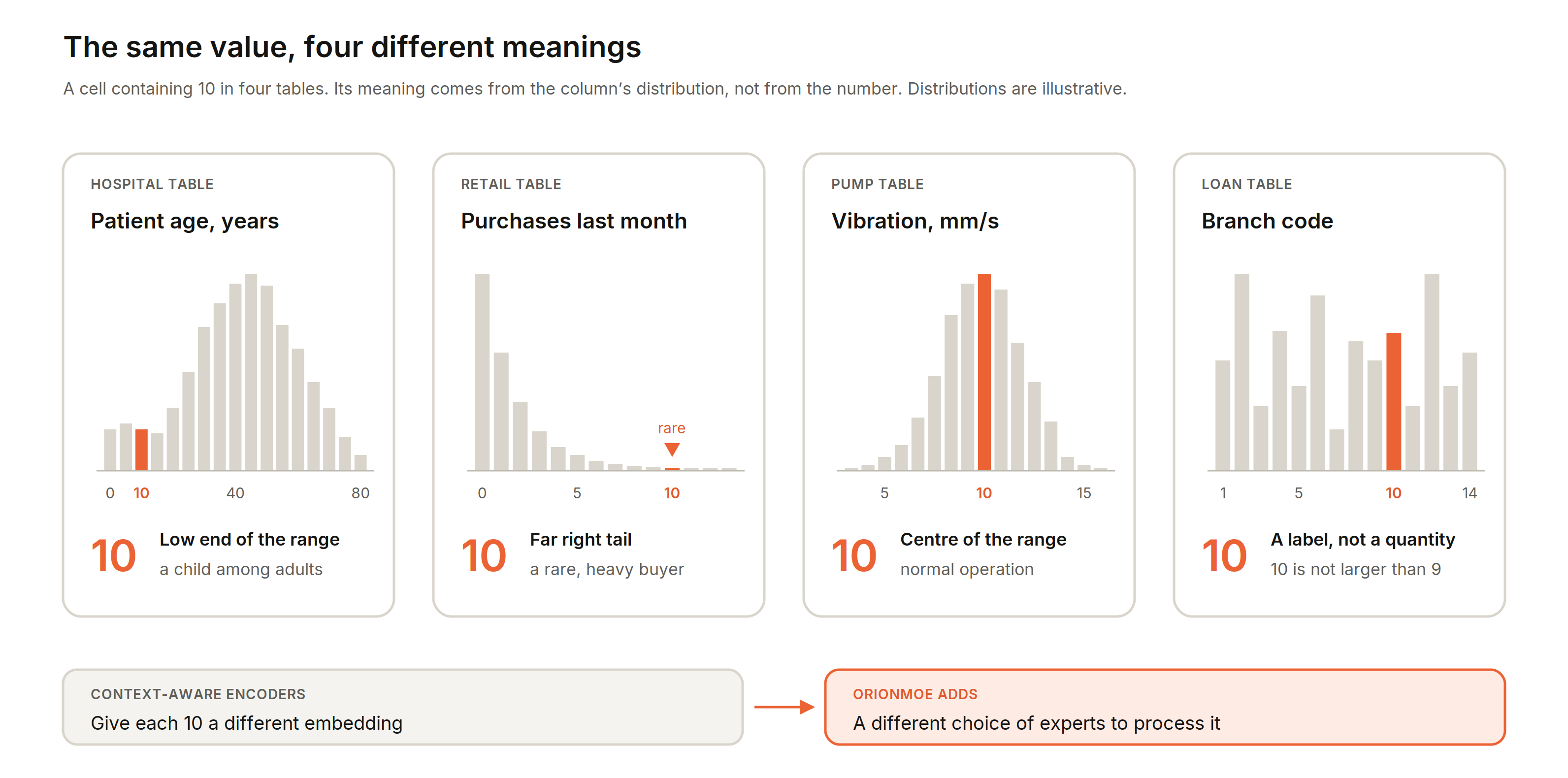
The field’s dominant response has been to adapt representations: encode each cell in the context of its column and its dataset, so that two identical values can mean different things. That is necessary, and OrionMoE invests heavily in it. But it may not be sufficient. When every dataset flows through the same dense transformations, a single set of weights must serve skewed and symmetric distributions, binary and high-cardinality features, ten-row and ten-thousand-row contexts, balanced and badly imbalanced targets. All of that diversity competes for the same shared capacity.
Our hypothesis is simple to state. If heterogeneity is the defining property of tabular data, a model should be able to adapt not only what it represents, but how it computes.
3. Why Mixture-of-Experts, and why the router must see the dataset
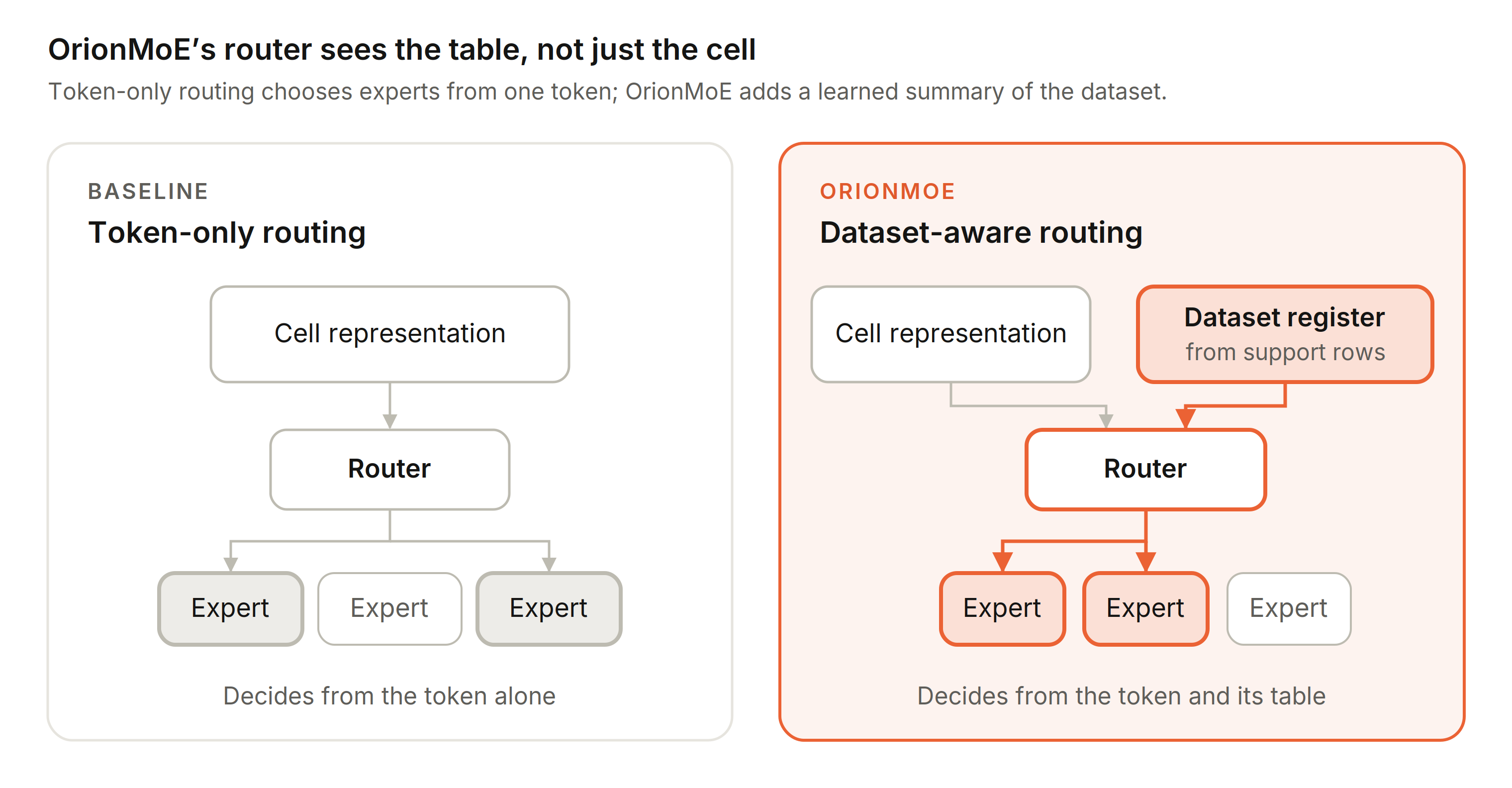
A sparse MoE layer replaces one dense feed-forward network with a set of expert networks and a router that sends each token to a small subset of them (Shazeer et al., 2017; Fedus et al., 2022). The model gains a larger repertoire of transformations while evaluating only a few experts per token. In language models the router usually decides from the token’s own representation, which works because tokens carry broadly consistent meaning across inputs.
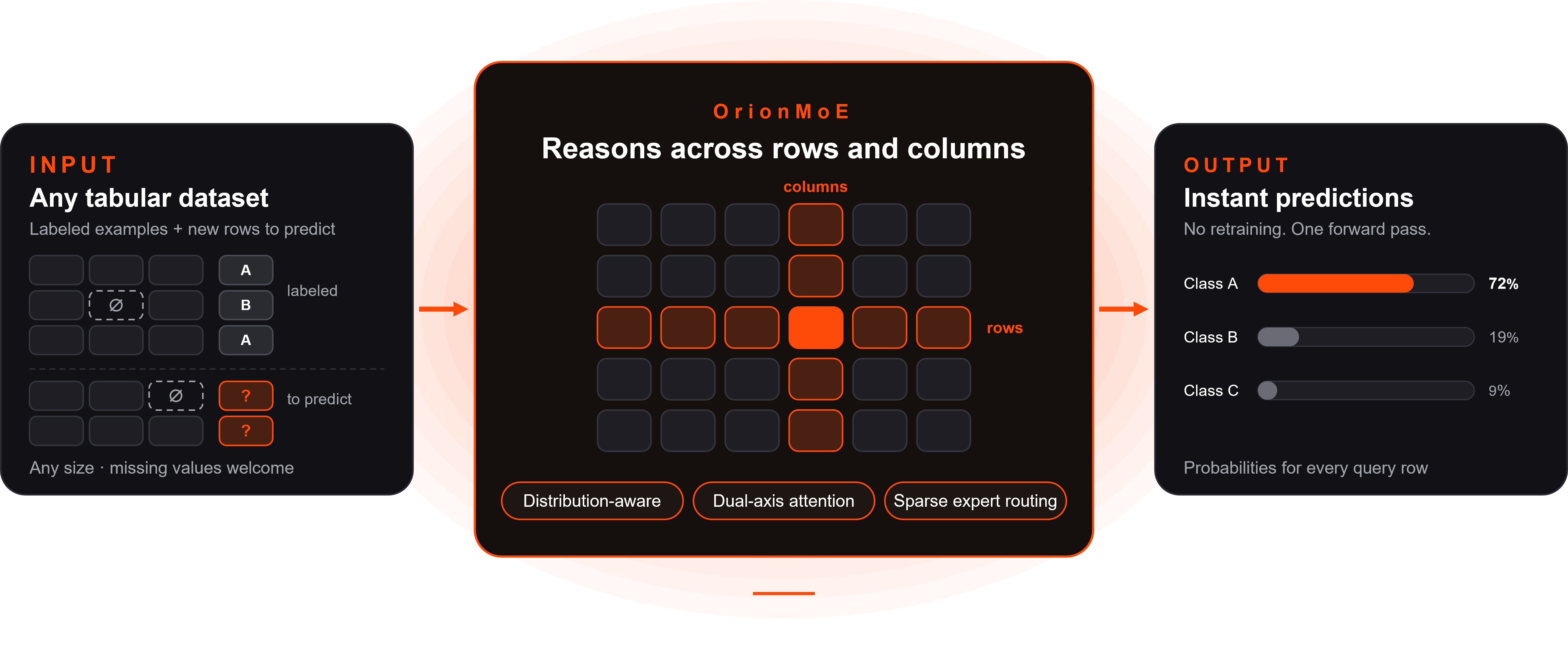
Tabular feature tokens do not. A router that sees a single token cannot tell whether it comes from a skewed column, a high-cardinality categorical, or a dataset with a rare target class. OrionMoE therefore asks its router a richer question. It conditions expert selection on two signals at once: the local representation of each cell, and a learned summary of the dataset derived from the labeled support examples. Two tokens with similar local representations can then be sent to different experts when they occur in different datasets, and tokens from different datasets with similar computational needs can share experts.
4. How OrionMoE relates to prior MoE work in tabular learning
5. Inside OrionMoE-Small-v1.0
Most tabular foundation models adapt only their representations. OrionMoE-Small-v1.0 also adapts the computation applied to them: for every table, in a single forward pass, it selects which experts process each feature token. Three design choices make this possible:
6. Do the experts specialize by dataset?
The most interesting question about a dataset-aware router is whether it uses the dataset at all. If routing collapsed to a few universal experts, or ignored the dataset register, the architecture would be MoE in name only.
It does not appear to. Across our routing analysis, expert selection is statistically associated with properties of the dataset: context size, dimensionality, class imbalance, and feature composition. Associations are measured as standardized effects between each characteristic and how often an expert is selected, and are tested with Benjamini–Hochberg correction for false discovery.
The patterns are distinct rather than uniform. One expert is selected more often as context size grows but less often as dimensionality rises, and is disfavored on binary-only and numeric-only tables relative to mixed-type ones. Another shows the opposite tendency on dimensionality and is favored on binary-only tables. A third becomes markedly less active as dimensionality increases. Different experts, in other words, appear to have settled into different statistical regimes.
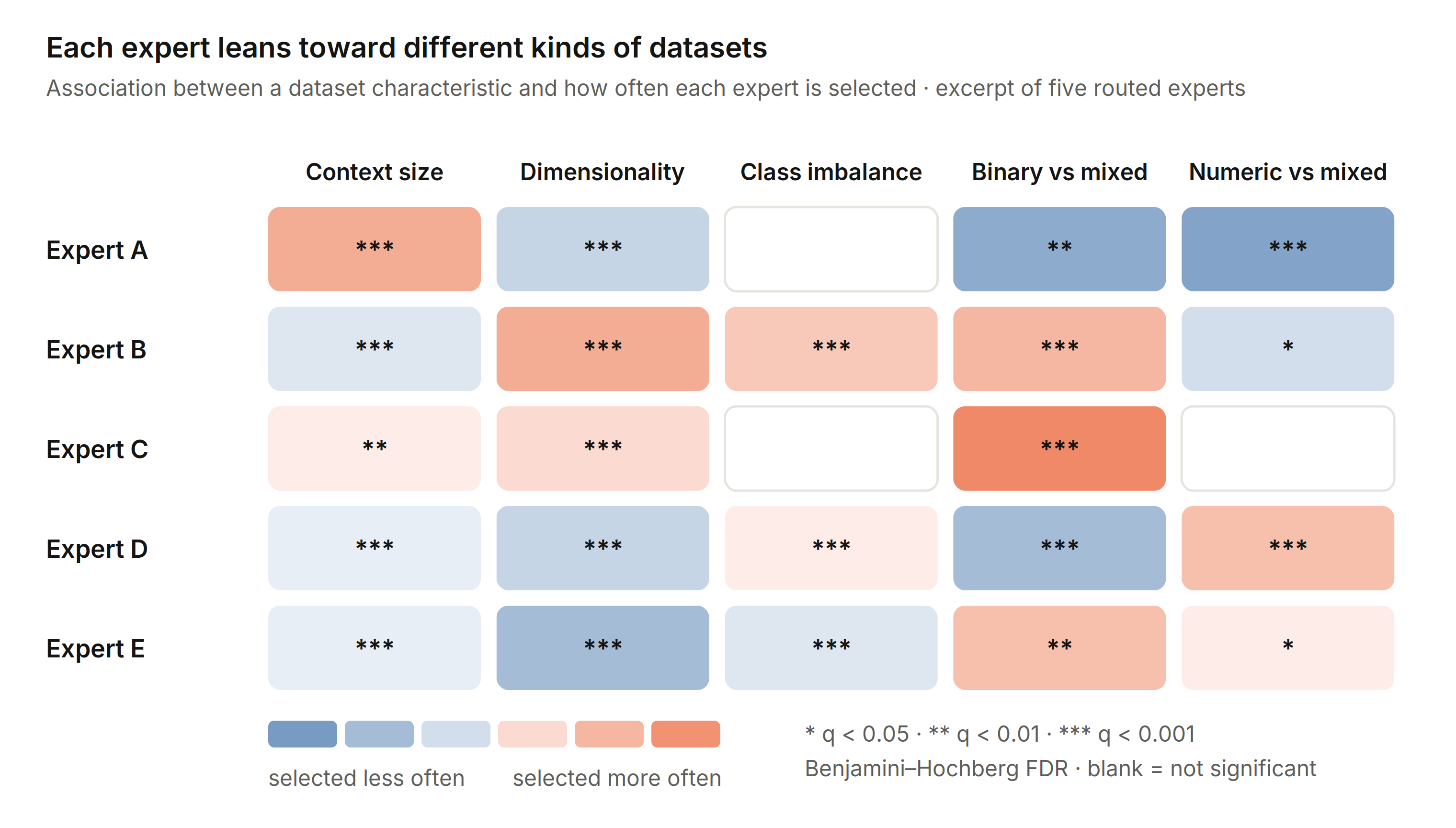
These are associations, not mechanisms. They do not yet tell us what each expert computes, or how much of the model’s accuracy depends on this division of labor. But they are exactly the signature one would hope to see: a router that was given access to the dataset, and was never told what to do with it, learned to send different kinds of tables down different paths.
7. The evidence: a compact model in a field of larger ones
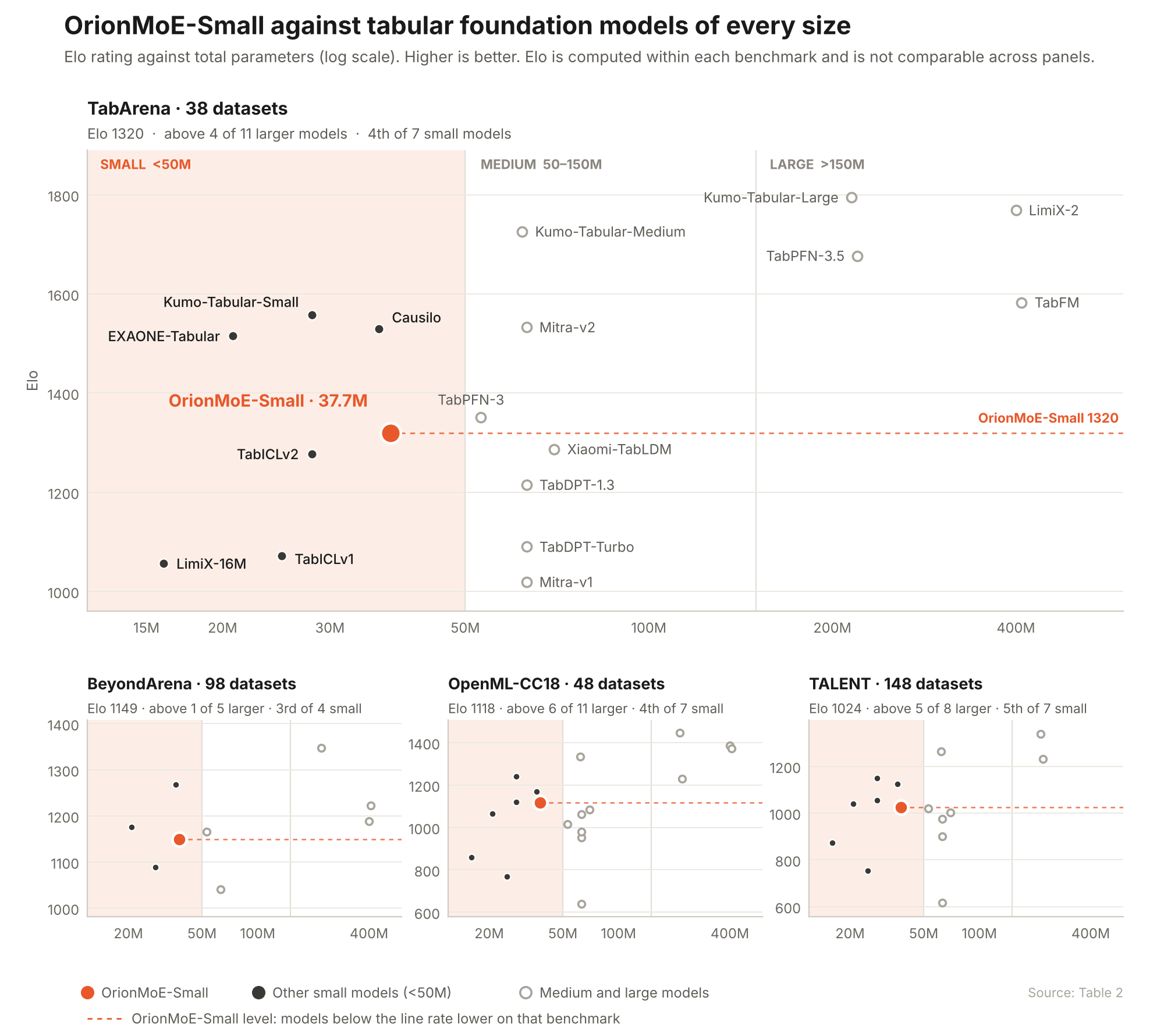
We evaluated OrionMoE-Small-v1.0 on five benchmark suites (TabArena, BeyondArena, OpenML-CC18, TALENT and BCCO) against recent tabular foundation models and established baselines. OrionMoE-Small-v1.0 is the first version of a new architecture, and it asks whether a backbone built on dataset-conditioned experts can stand alongside frontier dense tabular foundation models at a modest parameter budget. The results suggest it can. Figure 6 places every model by size and rating on each suite; Table 2 gives the full numbers, grouped by size.
| Model | Params (M) | TabArena | BeyondArena | OpenML-CC18 | TALENT |
|---|---|---|---|---|---|
| Small models (<50M parameters) | |||||
| Causilo | 36.1 | 1530 | 1268 | 1170 | 1125 |
| OrionMoE-Small MOE | 37.7 | 1320 | 1149 | 1118 | 1024 |
| TabICLv2 | 28 | 1277 | 1089 | 1121 | 1054 |
| TabICLv1 | 25 | 1072 | – | 768 | 753 |
| LimiX-16M | 16 | 1056 | – | 859 | 872 |
| Kumo-Tabular-Small | 28 | 1558 | – | 1241 | 1150 |
| EXAONE-Tabular | 20.8 | 1515 | 1176 | 1066 | 1040 |
| Medium models (50–150M parameters) | |||||
| Kumo-Tabular-Medium | 62 | 1726 | – | 1334 | 1265 |
| TabPFN-3 | 53 | 1351 | 1166 | 1015 | 1021 |
| TabDPT-1.3 | 63 | 1215 | 1041 | 1061 | 974 |
| TabDPT-Turbo | 63 | 1090 | – | 952 | – |
| Mitra-v1 | 63 | 1019 | – | 638 | 616 |
| Mitra-v2 | 63 | 1533 | – | 980 | 901 |
| Xiaomi-TabLDM MOE | 70 | 1287 | – | 1083 | 1002 |
| Large models (>150M parameters) | |||||
| Kumo-Tabular-Large | 215 | 1795 | – | 1447 | 1338 |
| TabPFN-3.5 | 220 | 1677 | 1348 | 1231 | 1231 |
| LimiX-2 | 400 | 1769 | 1188 | 1387 | – |
| TabFM | 408.7 | 1583 | 1222 | 1372 | – |
The table also shows clear headroom. Several models in our own size class, including Causilo, Kumo-Tabular-Small and EXAONE-Tabular, score higher on TabArena. This is version 1 of a new architectural direction, and we report the full picture because both what it achieves and how far it can still go are part of the result.
8. Beyond bigger Transformers
9. Early access