Tabular foundation models solved a real problem (in-context learning on structured data, no training required) and then immediately created a new one: every model family ships its own API, its own preprocessing assumptions, and its own idea of what fine-tuning even means. Comparing TabPFN against TabICL against Orion-MSP means writing three different integration paths before you've compared a single metric.
TabTune collapses that into one interface, built around four components:
- DataProcessor. Model-aware data preparation: imputation, scaling, and encoding handled per model family, so you're not hand-tuning preprocessing for each one.
- TuningManager. The engine underneath, deciding whether a model runs zero-shot inference, episodic fine-tuning, full fine-tuning, or PEFT/LoRA adaptation, depending on what the model family actually supports.
- TabularPipeline. The interface you actually touch:
.fit(),.predict(),.evaluate(),.save(),.load(). Same four methods, whichever of the 12+ model families is underneath. - TabularLeaderboard. Runs multiple models against the same task and ranks them, so "which model is actually best for this dataset" has a real answer instead of a guess.
TabTune supports TabPFN (v2, v2.6, v3), TabICL (v1, v2), Mitra, ContextTab, TabDPT, LimiX, and Lexsi's own Orion-MSP and Orion-BiX, each with the adaptation strategies that model actually supports: inference, meta-learning, SFT, native fine-tuning, or PEFT/LoRA.
Past basic fit-and-predict, TabTune covers the parts of a real tabular ML workflow that foundation models don't usually touch:
- Causal inference. Double Machine Learning, S/T/X/R-Learner, and Causal Forests, for teams that need treatment-effect estimates, not just predictions.
- Ensembling. Six strategies, including weighted averaging and cascade stacking, to combine foundation models rather than pick just one.
- Model compression. TabDistiller distills a tabular foundation model teacher down into a LightGBM, XGBoost, CatBoost, or MLP student, for when you need the accuracy without the inference cost.
- Fairness auditing. Proxy attribute detection and counterfactual fairness evaluation, built into the same pipeline.
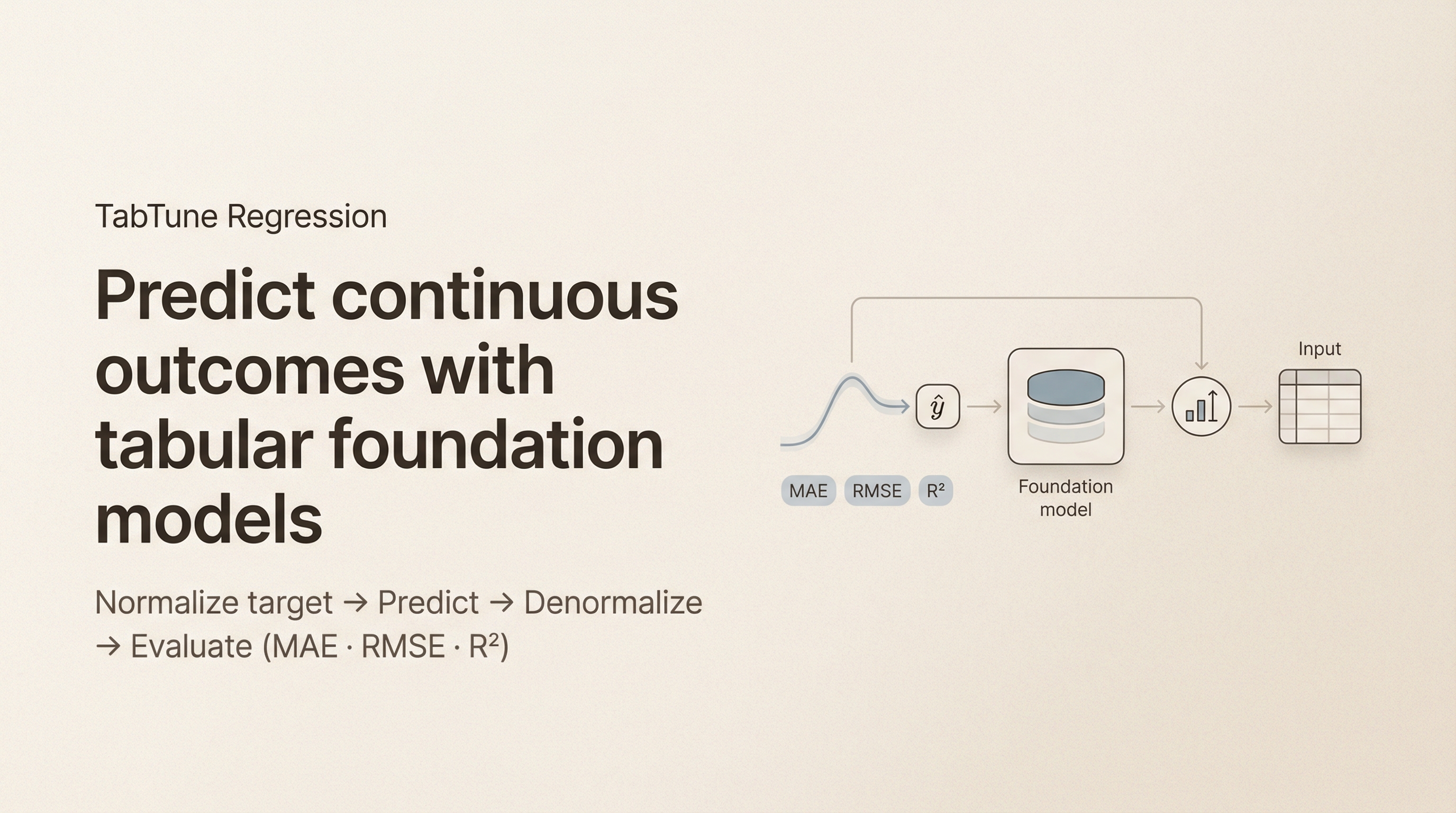
- Evaluation metrics. Classification (accuracy, F1, ROC AUC, MCC, Brier score) and regression (RMSE, MAE, R²), computed the same way regardless of which model produced the predictions.
17 example Colab notebooks are included in the documentation, covering each model family and workflow.
Who it's for
- ML teams evaluating multiple tabular foundation models who don't want to write a separate integration for each one.
- Teams that need causal effect estimates, fairness audits, or model compression alongside standard tabular prediction, in the same pipeline.
- Anyone building on Lexsi's own Orion-MSP or Orion-BiX models who wants the same interface as the rest of the tabular foundation model ecosystem.
Links:
- arXiv: https://arxiv.org/abs/2511.02802
- Docs: https://tabtune.lexsi.ai/
- Authors: Aditya Tanna, Pratinav Seth, Mohamed Bouadi, Utsav Avaiya, Vinay Kumar Sankarapu